

WRITTEN IN STONE
Follow our blog for the latest news, insights,
useful tips and all other Blue Pearl Stone related updates!

Universal Design in River North

Katy and Brad are recent empty nesters who traded in their house in the suburbs for a new life in the River North neighborhood of Chicago. Downsizing and choosing a new home is tricky, but this couple had the additional obstacle of finding a place suitable for Brad’s unique needs. At the age of 40, Brad became unexpectedly disabled, losing his hands and feet. At home, he uses an electric wheelchair and needs accessible showers. However, Katy and Brad did not want to settle for everyday metal grab bars and plastic shower seats in their search. Instead they envisioned a contemporary, urban loft that did not feel like an institution.
Blue Pearl Stone collaborated with John Kelly Architects and Designer, Page Redding to develop such a design for this challenging and rewarding project.
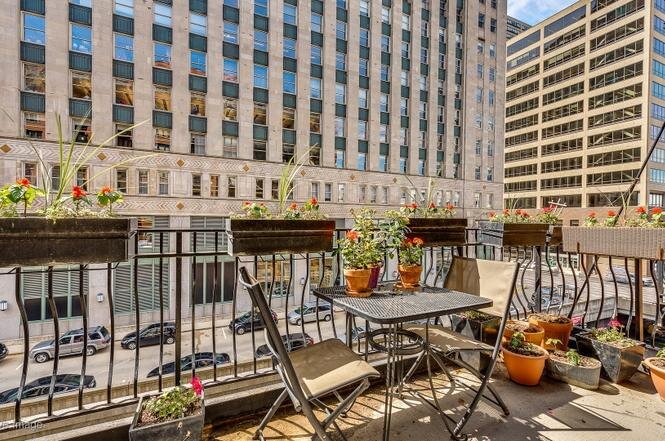
The newly renovated unit is located on the fourth floor of a converted factory building, complete with floor-to-ceiling views of the historic Merchandise Mart. The Mart’s façade provides a backdrop of weathered limestone and terracotta that serve as inspiration for matte-finished Artisan Grey quartz and honed Calacatta Apuano marble in the kitchen and living areas.
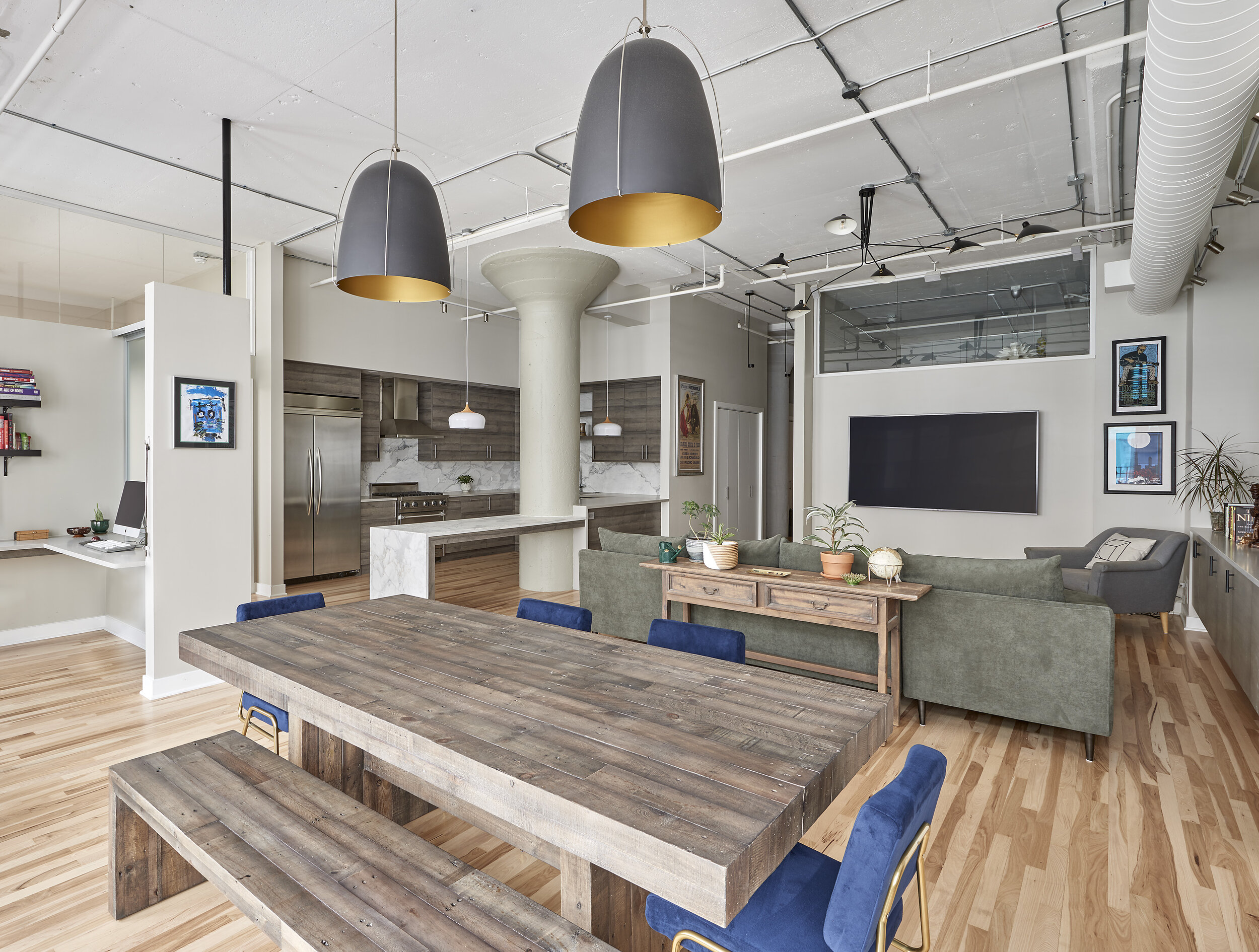
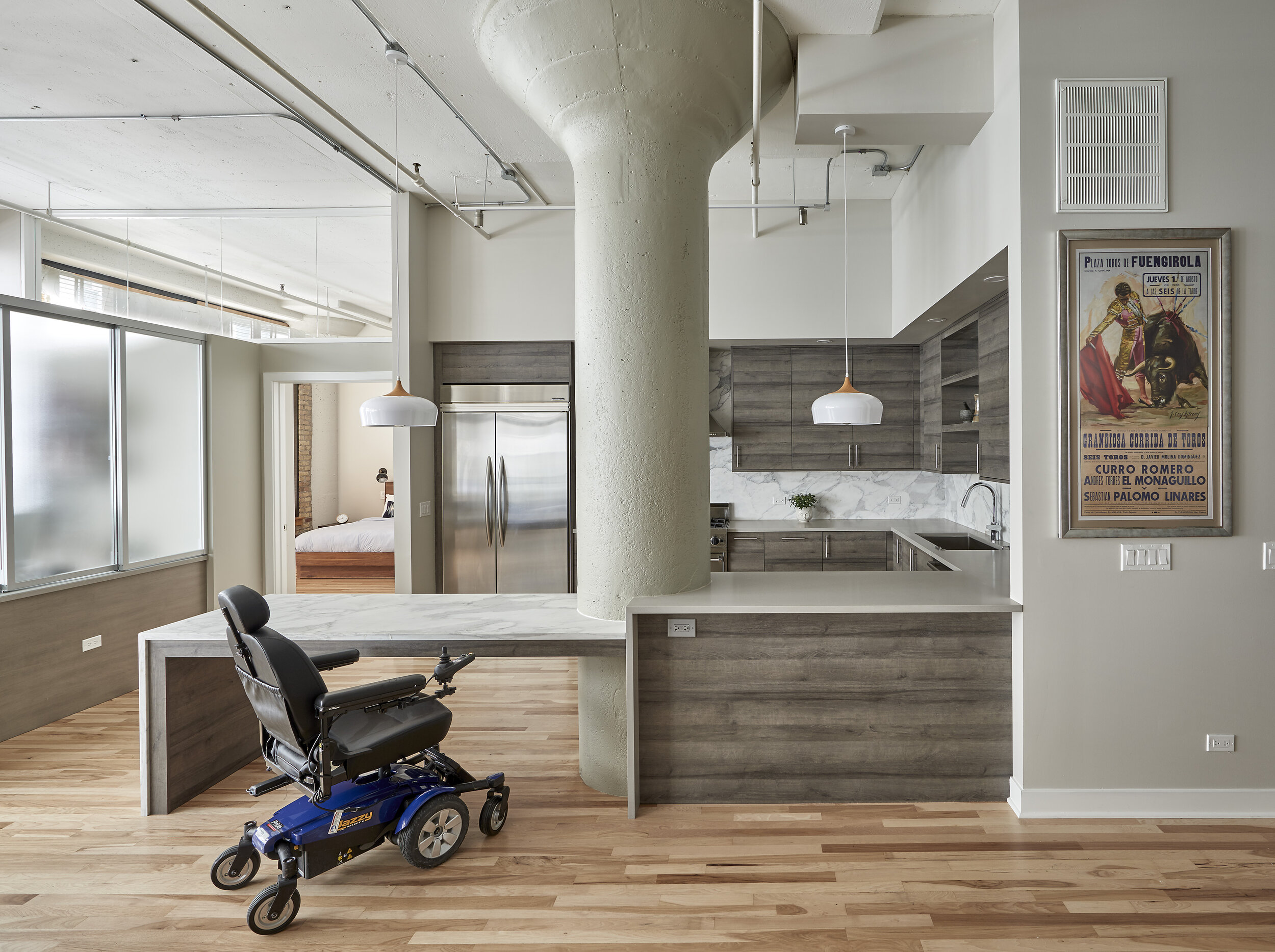
Merging industrial concrete elements with elegant waves of milky white, grey, and taupe veined marble, the condo pays homage to its landmark surroundings, while distinguishing itself as a contemporary, yet warm and comfortable home. The table height bar and eating area, ADA compliant cabinets and stainless sink all allow easy access, while integrating a gracious corner marble bookmatched backsplash, shelves and lighting. In other words, the home is Universal, yet sacrifices nothing in its aesthetic.
“Our condo does not look like it was made for someone who uses a wheelchair,” said Katy. “It flows, and there’s room to move. This is the heart of Universal Design. It works for everybody.”
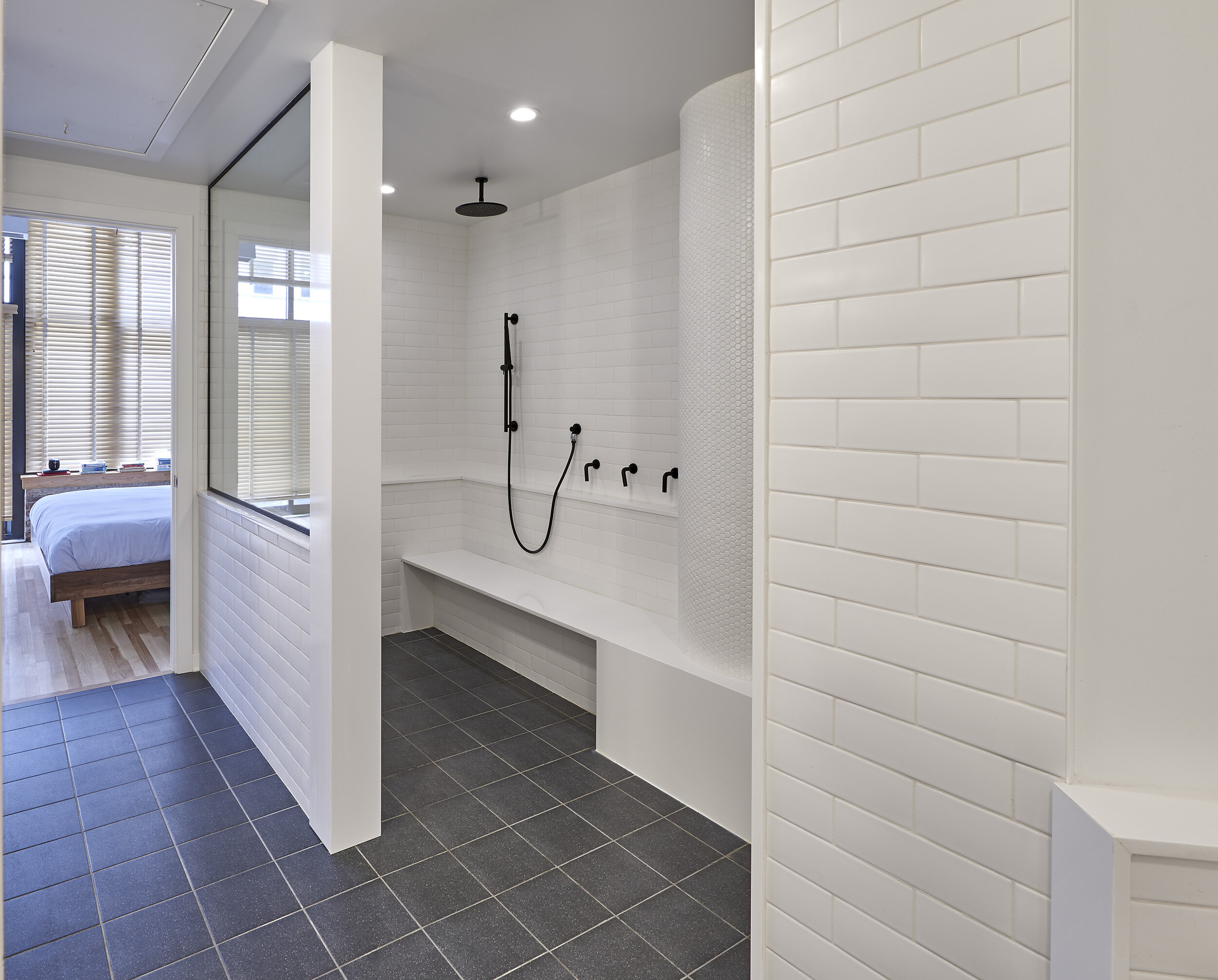
Take for example, the Master Bath. The walk-in shower, mitered sculptural bench, and floating vanities make it feel like a luxurious spa. But all these elements serve as important functions for Brad’s freedom of movement. The minimalist design of the low-maintenance Royal Blanc quartz shelving and ledges provide storage and accessibility and provide contrast to the high-durability Nero Erte porcelain floor tile. Each element complements another and works hard in both design and universality.
Universal Design inspires new inclusiveness in design and architecture to address individualized needs for comfort, style and harmony for all.

Kitchen Interior with quartz counters and marble full high splashes.

Bi-level Kitchen Bars in marble and quartz

Shower Area with Sculptural Quartz Bench, elongated Powder Subway Brick, Hexagon Penny Rounds and Nero Erte Floor Tile.

Master Bath Overview with Royal Blanc Quartz Counters, Columns, and Accessories, with Nero Erte Matte Porcelain Tile
Marble, Quartz and Tile by Blue Pearl Stone Photography by Tony Soluri
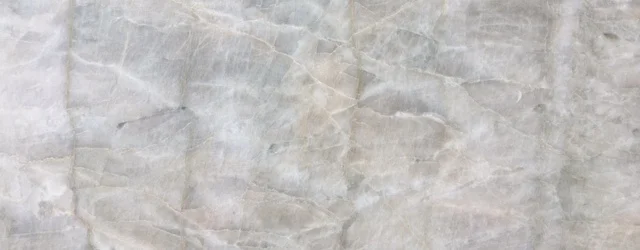
Quartz vs. Quartzite
Both quartz and quartzite are great for kitchens and bathrooms. But with any stone, the question is not about which material is better. Rather, the question is which stone is more suited for your needs.
We’re often asked how quartz and quartzite countertops exactly differ. With similar names, the question is raised with good reason. But to understand the differences between quartz and quartzite countertops, we must first clarify that the mineral “quartz” and “quartz countertop” belong to two different categories.

Quartz surfaces are non-porous and require no sealing
Quartz: mineral and countertop
In geology, “quartz” refers to one of the most abundantly occurring minerals in Earth’s surface. More strictly speaking, it refers to the chemical compound silica, i.e. silicon dioxide (SiO2). When looking at quartz as a mineral, you’ll find that granite, onyx, quartz, slate and soapstone countertops all contain the mineral quartz in varying degrees.
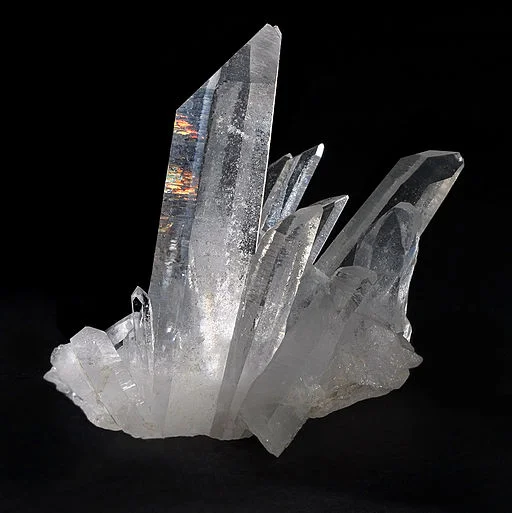
Quartz crystal cluster
But when we speak of quartz countertops in the stone industry, we are talking about a manufactured product, sometimes referred to as “engineered stone.” Quartz countertops are produced by using loose quartz, mineral pigment and an industrial resin binder. Since there is over 90% of loose quartz content in quartz countertops, the stone industry simply refers to these surfaces as “quartz.”
Quartz: Features
Given that quartz surfaces are man-made, they come in any color and pattern imaginable. Keep in mind, though, that quartz countertop patterns are often more uniform and repetitive than the patterns of natural stones. Since industrial resin binds the quartz minerals together, the countertop's surface is non-porous and requires no sealing; however, quartz countertops are sensitive to heat above 300 degrees Fahrenheit. In addition, quartz is more flexible than quartzite, less prone to chipping, and out of all the surfaces, maintaining quartz countertops is by far the easiest.

Quartz surfaces are sometimes referred to as "engineered stone"
What is quartzite?
Quartzite is a naturally occurring metamorphic rock that began its life as pure quartz sandstone. Over millions of years, sandstone morphs into quartzite under the extreme pressure and heat underneath the surface of the Earth.

Pink and red hues in quartzite are due to the presence of iron oxide
Quartzite: Features
Due to its natural origins, no two slabs are the same. The color range of quartzite countertops usually falls within the white, gray and beige spectrum. However, pink and red hues are common due to the iron oxide in the stone, as well as yellow, blue, green and orange hues that are a result of other naturally present minerals. Because of the subterranean pressure that helps form quartzite, the slabs have streaked patterns similar to marble. Quartzite is heat resistant and slightly harder than granite. Quartzite surfaces are sometimes porous, which means that they require periodic sealing and more meticulous care than quartz surfaces.
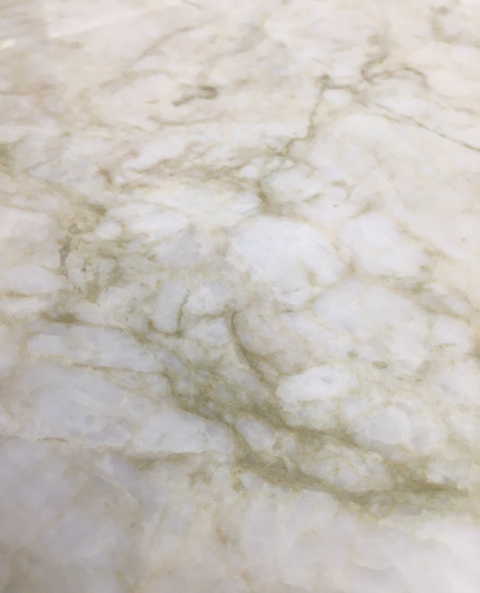
Quarzite has streaked patterns similar to marble
Conclusion
Both quartz and quartzite are great for kitchens and bathrooms. But with any stone, the question is not about which material is better. Rather, the question is which stone is more suited for your needs. Both quartz (Mohs scale of mineral hardness: 7) and quartzite (Mohs: 7-8) are comparable and often harder than granite (Mohs: 6.5-7). With quartz, you get a low-maintenance surface that comes in a myriad of colors, even though it isn't fully heat resistant. With quartzite, you get the unique look of natural stones and a harder, more durable surface, although periodic sealing is suggested. In terms of pricing, it all depends on the project at hand. However, if there are a lot of small details in your design, quartzite might put a heavier strain on your purse, given that the stone's hardness usually translates into more labor.
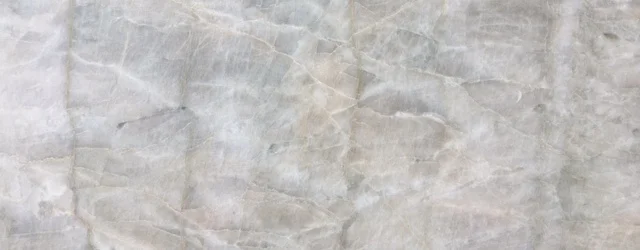
Quartzite has the unique look of natural stones
Quartz |
Quartzite |
|
|---|---|---|
| Source | Man-made | Natural |
| Color | Large spectrum | White, gray and beige |
| Pattern | Any pattern | Similar to marble |
| Natural streaks | ||
| Hardness | Mohs Scale: 7 | Mohs Scale: 7-8 |
| Maintenance | Minimal care | Simple care |
| No sealing required | Requires periodic sealing | |
| Heat resistant | No | Yes |