

WRITTEN IN STONE
Follow our blog for the latest news, insights,
useful tips and all other Blue Pearl Stone related updates!

What to Bring When You Visit Blue Pearl
Our job as design professionals is to listen and help you make the best decisions, and in order for us to assist you the best way we can, we need to learn about you and your project in as much detail as possible. To make your job easier, we have compiled a checklist for you to use and peruse, so you can come and see us fully equipped.
Congratulations and welcome! If you are reading this, that means that you have decided to take the plunge and take on a remodel or building project. Consequently, it also means that you have considered a visit to our shop in La Grange, thus taking an essential step towards a new and improved space.
Our job as design professionals is to listen and help you make the best decisions, and in order for us to assist you the best way we can, we need to learn about you and your project in as much detail as possible. To make your job easier, we have compiled a checklist for you to use and peruse, so you can come and see us fully equipped.

1. Drawing and Dimensions
If you have any drawings of your project, whether they are from a designer or a cabinet maker, it can help us jump-start the selection and design process. Even if you sketch your layout on a piece of coffee-stained napkin, that can ultimately help us find the most suitably sized slab. Drawings are also key for getting a quote. While square footage can be a good starting point, the quote is more reliant on the layout of the project and how we can fit that onto the slabs.

2. Color Palette
We pride ourselves on having a wide variety of resources on-site, such as paint swatches and cabinetry samples. However, color is one of the cornerstones of the design process, and it is crucial for us to know the context of your project. If there are any tiles, cabinetry, wallpapers, paint colors etc. in the surrounding space, snap a photo of them, or better yet, bring some samples along with you! We offer materials in a myriad of colors, and knowing the spectrum of your project can help us narrow down the possible choices.
3. Style
Tell us your ideas for style. Do you prefer traditional, contemporary, rustic, or transitional?
Are the countertops your focal point, or would you like them to complement the room? Anything that comes in mind can be helpful, so don’t shy away from sharing your preliminary ideas.
4. Collaboration
It also helps to know whether you’re working with a contractor or a designer. Your contractor may have specific ideas about the construction timeline, and your designer may have a more overarching vision for the space in question, thus potentially providing you with suggestions about what might need to be discussed when you visit us.
5. Timeline
Streamlining all the different aspects of a remodeling or construction project is where things can get tricky. But knowing, for instance, when your cabinets will be installed, or when the tile setters are due, will allow us to conform our schedule to yours, and make the entire workflow harmonious.

We hope you find this checklist helpful, and we look forward to seeing you soon! Call us to set up an appointment and to get started on a well-designed project!
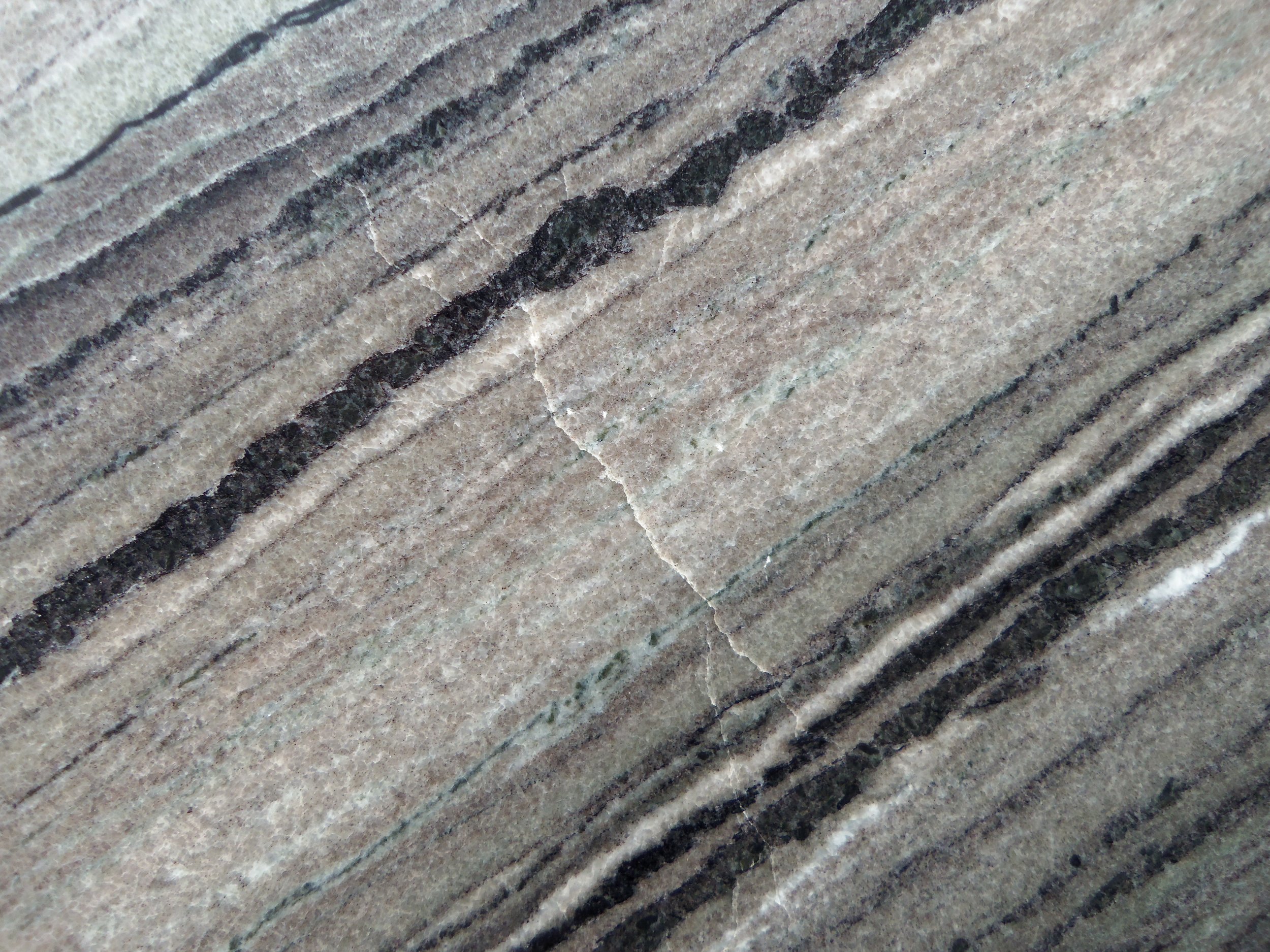
Natural Stone: Not a Game of Perfect
Here at Blue Pearl Stone, we are yet to see a perfect slab of natural stone. This is not because of some mystical curse or an outlandish series of mishaps. Natural stone, by nature, is always imperfect.
It might have been Dale Clevenger, former principal horn of the Chicago Symphony Orchestra, who at one point during his illustrious career surprisingly said that he is yet to perform a perfect concert. Whether it was truly him who said it, this sort of notion really hits close to home: here at Blue Pearl Stone, we are yet to see a perfect slab of natural stone.

Naturally occurring crack in a slab of Zsa Zsa quartzite
This is not because of some mystical curse or an outlandish series of mishaps. Natural stone, by nature, is always imperfect. There will most likely be a slightly brownish patch somewhere on a beautiful white Carrara marble, a tiny pit in a Luna Pearl granite slab, and amongst the undulating wave-patterns of a Macauba quartzite you may just happen upon a cloudy patch. Natural stone just won’t stand up to the fastidious scrutiny of perfectionists.

Pits filled with resin in a slab of Noce Travertine
And it really shouldn’t. The real beauty of any natural stone comes from its unabashed uniqueness. Natural stones are either formed under subterranean pressure, are a result of sedimentation or a product of volcanic activity. But wherever they might come from, the thousands and millions of years that it takes for these stones to form means that each slab is exposed to the caprices of time and stands as a testimony to all the events that occurred during its formation: a slight drift in the tectonic plates, a trapped and fossilized organism here and there, or the leaking of an uncommon material into the ossifying sediment. You name it.

Rock sedimentation at the blue lias cliffs at Lyme Regis - Wikipedia
In granite, for example, there’s a mineral called biotite, which is softer than granite's other components. The main components of granite, feldspar and quartz (the mineral), have the hardness of about 6.5-7 on the Mohs scale. But biotite's is only 2.5. This means that biotite flakes and crumbles more easily compared to the other minerals, sometimes leaving tiny pits behind. Yet, this by no means compromises the integrity and durability of granite.

Fissures and pits filled in with epoxy resin in a slab of Noce Travertine
Or take fissures for instance: fissures are natural cracks that can be found in the surface of stones. Most are almost undetectable, but some are wide enough that quartz bits and epoxy resin are required to fill them in. Mining companies extract stone out of the ground in large cubes (see video), then slice the cubes up like bread. Cracks can occur during these processes, but if the accidental crack doesn’t entirely damage the integrity of the stone, it’s immediately restored with resin, and can go on the market.
We've also received requests for service calls regarding cloudy patches on countertops. In certain natural stones there will be areas that have a slightly different composition than the rest, and which, accordingly, take polish differently. The results are occasional cloudy patches and they, too, are perfectly natural.
For some inspiration and encouragement, let us suggest an article by Faith Durand, blogger and author of several cookbooks, in which she elaborates on her penchant for so-called etchings. While etchings are man-made marks on countertops, the accepting and easygoing approach of a professional cook in these matters can be quite reassuring, especially for those with misgivings about purchasing natural stone products. Click on the link to read Faith Durand's "Here's What an Etch on a Marble Countertop Actually Looks Like" article, and do not hesitate to reach out to us should you have any questions.

Blue Pearl Stone Website Launch
Our website was due for an update in order to better and more accurately represent the progress that we've made over the recent years, and today we are finally ready to unveil our new online identity.

Welcome to our new digital home!
Our website was due for an update in order to better and more accurately represent the progress that we've made over the recent years, and today we are finally ready to unveil our new online identity.
We have always addressed our customers needs and wants with an enthusiasm for beauty and a respect for the environment, and we've strived to set the standard in our industry for technological advancements in fabrication and installation. In this vein, the pure white, blue and grey color of the website evokes beauty and clarity, and the new semi-serif company logo simultaneously pays homage to the stone industry’s rich history and alludes to our rapidly advancing world.

We hope you’ll enjoy browsing our new website, and be sure to sign up to our newsletter so you can receive the latest Blue Pearl updates as well as our Written in Stone blog posts.
Thank you for visiting our new site! We look forward to seeing you soon!
Yours truly,
The Blue Pearl Stone Team